
The 30-share Sensex, after opening on a strong footing, continued its upward march to hit an all-time high of 35,827.70. The NSE Nifty also hit a record intra-day high of 10,975.10, before finishing at 10,966.20, up 71.50 points.
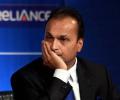
Who is to take their place? Will a new generation of entrepreneurs start up with better business sense, or at least better luck? But the so-called unicorns are mostly copy-cat entrepreneurs whose cash flow is funded by overseas (including Chinese) money, notes T N Ninan.

The sentiment got support from better-than-expected earning results by select companies and continuous buying by domestic financial institutions.

Without exception, the top four majors beat Street estimates across all parameters - revenues, profitability, or net profit growth. However, what stood out were the large deal wins reported by the big two, TCS and Infosys.

'This encourages escapism through the politics and economics of nationalism, made worse by tribalism or nativism, the package accompanied inevitably by the erosion of institutional bulwarks and therefore State capture by powerful businessmen,' notes T N Ninan.

'Everything will be decided by the Centre.' 'Universities will have no autonomy to start a new course or introduce a new syllabus.'

The new executive director of Reliance Capital has big shoes to fill in every way.
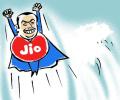
Investments totaling over $9.5 billion in Jio Platforms by a clutch of private equity firms, following social media giant Facebook's $5.7 billion mid-April investment in the company, helped overall.

You may invest even at current market levels provided you have an investment horizon of five years or more.


Notable losers were ONGC, Axis Bank, ITC, SBI, ICICI Bank, NTPC, Hero Motocorp, Sun Pharma and Bharti Airtel who fell by up to 2.80 per cent.

The Nifty finished the day at 10,265.65, a hefty gain of 98.95 points, or 0.97 per cent, after shuttling between 10,270.85 and 10,195.25.
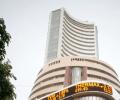
In a range-bound trading, the BSE benchmark Sensex ended a shade higher by 1.57 points in the special 90-minute trading today as funds refrained from making any major commitments in the absence of global cues.

'At a time when the economy is depressed, a pandemic is raging, and the Chinese are making noises on the border, the NRC could be resuscitated.'

Markets under pressure; IT financials grab spotlight.

Ideally, one should opt for a 5 to to 10- year period in an MF scheme or exit when the goal is reached.

Vodafone Idea will gradually lose market share given its weak balance sheet and limited financial flexibility, says Fitch.
Among the stocks that have seen the largest cut by MFs, the DVR shares (shares with differential voting rights) of Tata Motors have seen a cut of 243 basis points (bps) in MFs' stake.

The 30-share Sensex stayed in the green for the better part of the session and hit the day's high of 38,297.70 as buying pace gathered momentum towards the fag-end.

The circular says even a day's delay in servicing loans would be now taken as a 'default'. And once in default, for loans above Rs 2,000 crore, the banks will have to arrive at a resolution within 180 days, else lenders will have to file an application under the IBC within 15 days.
Reliance Industries Limited, the country's largest private sector company, is raising $2 billion through a 10-year overseas syndicated loan for funding its oil and gas exploration in the D6 block of the Krishna-Godawari basin.

Russian firms expand their footprint in India. And take bigger steps to do business with India's private sector.

In the Sensex pack, M&M was the biggest loser, tumbling by 6.66 per cent, followed by TCS dropping 4.14 per cent.

Several critics including some rating agencies have doubted prospects of meeting this ambitious fiscal deficit target.
The rupee resumed higher at 60.13 per dollar as against the last closing level of 60.20 at the Interbank Foreign Exchange market, and hovered in a range of 60.07 and 60.18 per dollar before quoting at 60.08 at 1000 hours.

Sesnsex ended the day flat on heavy selling pressure.
In the broader markets, the BSE Midcap and Smallcap indices extended gains and were up over 1% each

The move to allow payments through digital wallets could give a fillip to distribution and reach for these investment vehicles, say experts.

There will be tripartite pact with member, bank/housing agency and EPFO.

This is a part of the company's plan to raise $13 billion debt to fund expansion of its petrochemical production capacity and gasification project for its refining facilities to improve margins.

The BSE Midcap index has declined 5.7% thus far in May 2018. In comparison, the S&P BSE Small-cap index has lost 5.6%

The Ambani brothers, Mukesh and Anil, came together on Thursday to raise the issue of stalled projects plaguing India Inc and implored the Maharashtra government and the Centre to make Mumbai, India's financial capital, an easier place for business and investments. "Several projects are stuck for many years in Mumbai and we would like to know how the government intends to improve the financing and execution of projects, including those relating to infrastructure and education which have been in limbo for long and are affecting the growth of the city," Reliance Industries Ltd (RIL) Chairman Mukesh Ambani told Finance Minister Arun Jaitley. Seated on the same table was his brother, apart from Tata Group Chairman Cyrus Mistry and State Bank of India (SBI) Chairman Arundhati Bhattacharya. Jaitley was addressing the Mumbai Next MMR Transformation conclave, organised by the Maharashtra government and Mumbai First here, through video conference. In his reply, Jaitley said the government was exploring several options of infrastructure financing in India and that a number of international bodies were ready to fund infrastructure development projects. He added the government was keenly considering these funding sources. While praising Maharashtra Chief Minister Devendra Fadnavis for honesty, Jaitley also had a word of advice. Apart from being honest, the government had to be decisive, he said. On his part, Reliance Group Chairman Anil Ambani told the chief minister about his experience of decisions being delayed due to an indecisive bureaucracy and the need to protect officials who wanted to take quick decisions. "Through the past many years, we have faced a number of obstacles in decision-making," he said, adding he was speaking as someone who had lived and invested in Mumbai. Fadnavis responded by saying he would bring about a transparent process to ring-fence officials. Both the Ambani brothers have announced a number of infrastructure projects in and around Mumbai, including a world-class convention centre in Bandra Kurla Complex by RIL, but very few have actually fructified. RIL's special economic zone project failed to take off due to land acquisition problems in Raigarh, while a second SEZ near Mumbai is stuck due to lack of clarity in SEZ norms. The first phase of the Mumbai Metro, set up by Anil Ambani's Reliance Infrastructure, was marred by cost overruns and run-ins with the government over fares. Subsequently, the company withdrew from the second and larger phase, citing inordinate delay. Anil Ambani also withdrew from Mumbai's sea link project on the same grounds. The brothers had also bid for a trans-harbour sea link between Navi Mumbai and Mumbai under the Congress-Nationalist Congress Party government, but their bid was rejected. Reliance Infrastructure is also the power supplier to more than half of this city. Participating in the conclave, some of India Inc's leading bankers said making Mumbai a financial hub would take at least a decade. SBI's Bhattacharya said the Indian currency should be made fully convertible and facilities should be created for it. "However, for this, the economy needs to look up and that will happen only in the next 7-10 years, not immediately," she added. Sunil Kaushal, Chief Executive Officer of Standard Chartered, India, pitched for strong infrastructure to support development. "We will take a long time to develop into a global financial centre. We need to solve transport bottlenecks in Mumbai and have lifestyle facilities for people working in and around these areas," he said.
Ril's shale gas may be impacted due to fracking ban

Analysts attribute this outperformance to the government's proactive economic reform measures
The 30-share Sensex was up 191 points at 28,707.75 and the 50-share Nifty was up 54 points at 8,714.
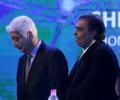
Additional levy to eat into Rs 6,000-crore income of top promoters
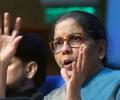
'The stimulus message was tagged on to what was meant to be an exhortation to self-reliance, glossing over the near impossibility of merging the immediate requirement of relief for a huge population and a questionable strategy for the future trajectory of a large economy aspiring to superstardom,' points out Shreekant Sambrani.

The weakness in the rupee and broader markets has led to evaporation in the market cap.

On the volume side, the number of M&A and PE deals was 110 in July, 15 per cent lower from 130 in July 2018.
 © 2026 Rediff.com - Advertise with us - Disclaimer - Privacy Policy - Sitemap - Feedback - About us - Terms of use - Grievances